Veneer repair accounts for a significant portion of furniture work at Canadian fix-it workshops. Mid-century pieces — produced during the 1950s through 1970s — commonly used walnut, teak, and rosewood veneer over particleboard or medium-density fibreboard substrates. These constructions age predictably: the veneer itself is durable, but the adhesive layer between veneer and substrate degrades with moisture cycles and temperature swings.
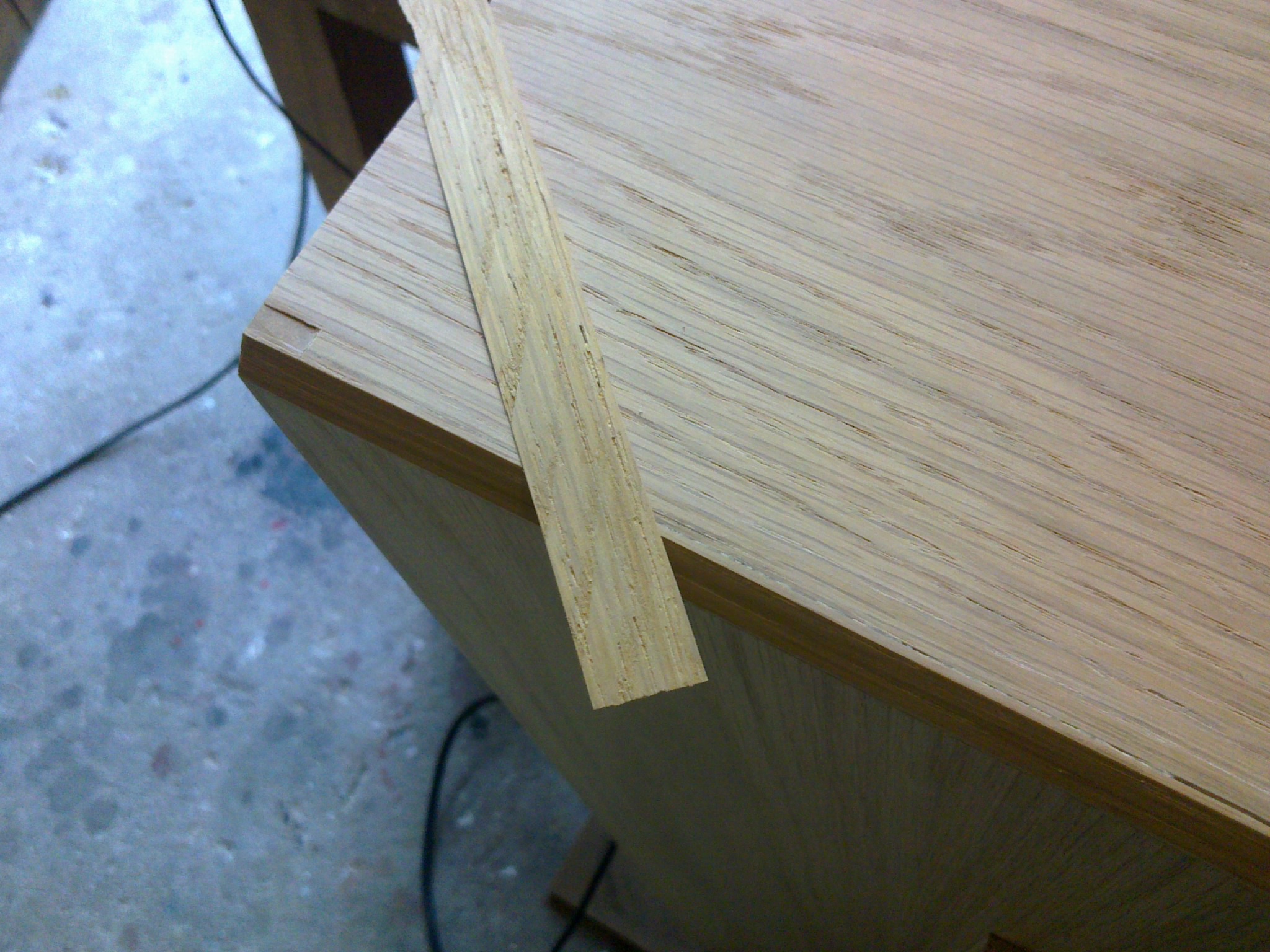
Understanding the failure types
Before choosing a repair method, the condition of the veneer and substrate must be assessed. The three most common failure modes each call for a different approach:
Lifted edges
The veneer has separated from the substrate at one edge but the panel itself is intact. The veneer is still present — it is not missing — and the surface beneath may be clean or may have dried adhesive residue. Lifted edges are the most straightforward condition to address.
Bubble or blister
The veneer has separated from the substrate across a circular or irregular interior area without separating at the edges. This condition often results from a concentrated moisture event — a plant pot, a glass without a coaster, or water seeping under a surface finish. The veneer may be flat or visibly raised.
Missing section
A piece of veneer has broken away entirely, leaving exposed substrate. Repair requires sourcing a patch material that approximates the original veneer species, thickness, and grain direction.
Materials used at repair cafés
Volunteer coordinators at Canadian repair sessions have converged on a short list of materials that handle the majority of veneer cases:
- PVA wood glue — for re-adhering lifted sections to clean substrate; water-based, sandable, and reversible with moisture
- Hide glue (hot or ground) — preferred for antique pieces where reversibility and period-appropriate materials matter; the Canadian Conservation Institute recommends reversible adhesives for culturally significant objects
- Veneer tape — paper-backed gummed tape for clamping lifted sections while adhesive cures
- Caul boards — flat scrap pieces of MDF or plywood used to distribute clamp pressure evenly over a patched area
- Veneer scrap collection — many repair cafés maintain a box of veneer off-cuts donated by local cabinetmakers or collected from scrapped furniture
Repairing lifted edges: step-by-step
This procedure addresses the most common case: a straight or gently curved edge lift where the substrate is intact and clean.
- Clean the substrate. Insert a thin palette knife or piece of playing card under the lift. If dried adhesive is present, soften it by placing a damp cloth on the veneer surface for 10–15 minutes, then scrape clean with the palette knife. The substrate must be flat and free of debris.
- Apply adhesive to substrate only. Using a cotton swab or a thin strip of card, apply a thin, even coat of PVA to the substrate surface — not the veneer. Applying to both surfaces creates a thicker glue line and makes final levelling harder.
- Press and tape. Press the veneer flat by hand, then apply veneer tape across the lifted area perpendicular to the lift direction, in strips 50–75 mm apart. The tape holds the veneer down while the adhesive begins to tack.
- Clamp with caul. Place a piece of waxed paper over the repair, then a flat caul board, then clamp or weight. Waxed paper prevents the caul from bonding to adhesive squeeze-out. Leave under pressure for at least two hours at room temperature.
- Remove tape and level. Peel veneer tape by dampening it with a wet cloth; never pull dry. If the repair surface stands slightly proud, sand carefully with 180-grit followed by 220-grit, following the grain direction.
Treating blisters
A blister where the veneer is flat (not raised significantly) can sometimes be re-adhered through heat alone. Place a cloth over the blister and press firmly with a household iron set to medium heat for 15–20 seconds. The original adhesive, if it is a thermoplastic type, may reactivate and re-bond. Check after cooling by pressing with a finger; if it still sounds hollow, proceed to the glue injection method.
For glue injection: use a hypodermic-style glue syringe (available from woodworking suppliers) to introduce a small amount of PVA into the blister. Work the adhesive across the blister area by pressing from outside inward. Clamp as described above. This method is slower but produces reliable results on blisters up to approximately 80 mm diameter.
Patching missing sections

Missing veneer requires a patch. The practical challenge is grain matching: the direction, figure, and colour of the patch must approximate the surrounding material closely enough to be inconspicuous.
Cutting the patch opening
A diamond or parallelogram shape, cut with the long axis following the grain, is less visually conspicuous than a rectangle with edges perpendicular to the grain. Use a straight edge and a sharp craft knife to cut the opening. Cuts that follow grain lines are harder to see than cuts across grain.
Fitting the patch
Select veneer from the scrap collection that matches the original in species (if identifiable) and grain direction. Cut the patch slightly oversized, fit it into the opening, and trim to final size by scribing along the opening edge. The patch should drop in flush with the surrounding surface with minimal pressure.
Adhering and finishing
Adhere using the same PVA and caul method described above. After the adhesive cures, sand the patch level. Colour matching with diluted oil-based stain or furniture markers brings the patch tone closer to the surrounding material. A final application of finishing oil or wax brings the sheen into alignment.
What cannot be repaired at a community session
Some veneer conditions are outside the scope of a typical one-session repair café intervention:
- Veneer that has checked (developed multiple small cracks across the entire surface) due to chronic dryness — stabilisation is possible but full cosmetic repair requires professional refinishing
- Substrate damage — if the particleboard or MDF beneath has delaminated, swollen, or crumbled, the veneer cannot be reliably re-adhered without substrate repair or replacement first
- Chemical damage from solvents — if the finish has been attacked by a solvent spill, the veneer below may have discoloured irreversibly
Related: Joinery Checks Guide → Tool List for Repair Cafés →