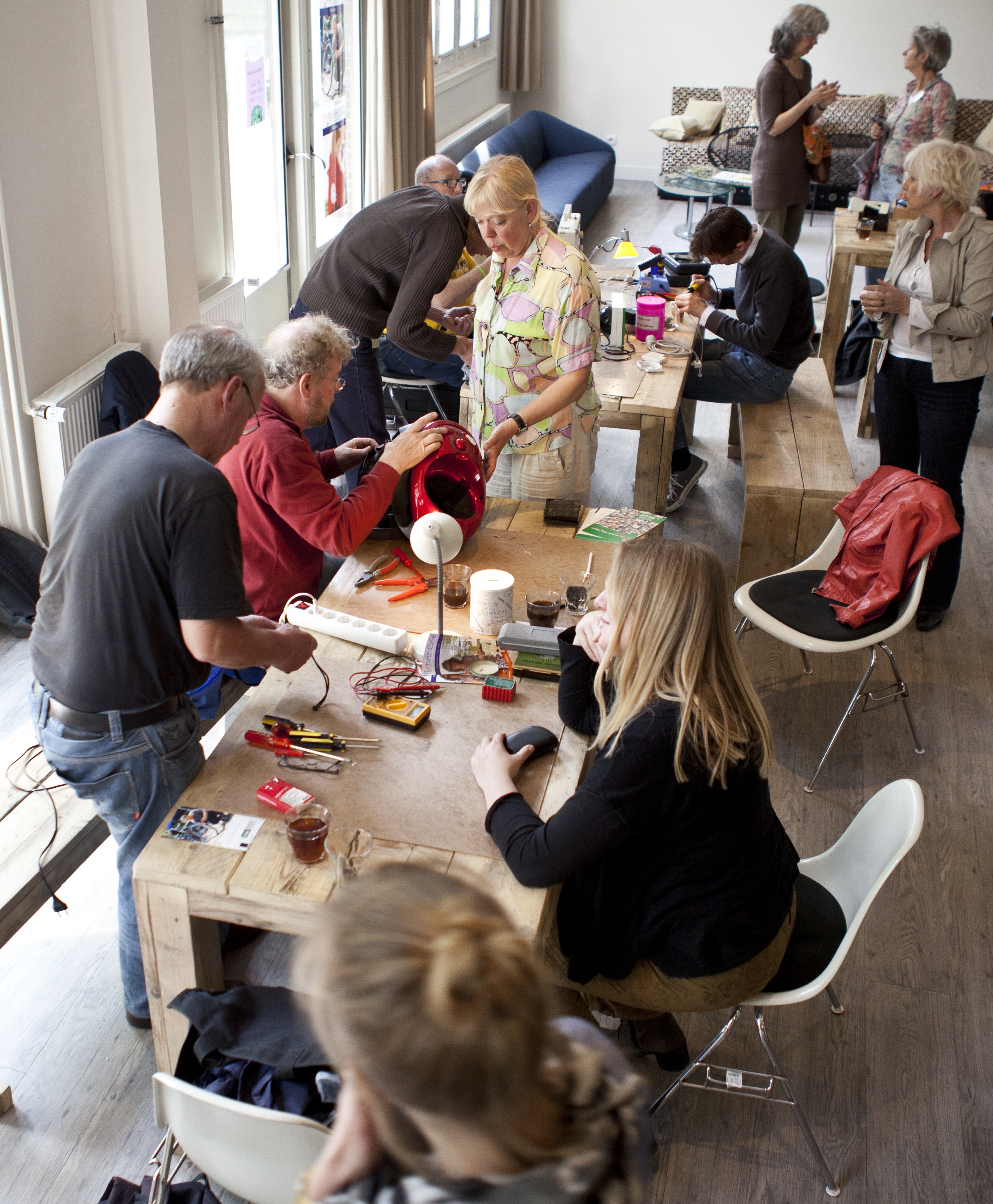
Repair cafés operate on a practical constraint: the tools available must handle a wide variety of furniture problems brought by the public, fit into transportable storage, and be safe for use in a semi-public setting by volunteers with varying skill levels. This list reflects the equipment choices documented at working sessions in several Canadian provinces.
Measuring and marking
Accurate measurement is the starting point for nearly every repair task. The core measuring set:
- Steel rule, 300 mm — for small measurements and as a straight edge when scribing veneer patches
- Combination square — for checking squareness of frames and marking perpendicular lines
- Marking knife — for precise cut lines in veneer work; a craft knife with fresh blades serves the same purpose
- Pencil and chalk — pencil for wood surfaces; chalk for marking positions on upholstered pieces
Cutting tools
The cutting tools at a furniture repair session address veneer work, dowel extraction, and surface preparation — not furniture fabrication. Power tools are generally avoided at public sessions for safety reasons.
- Craft knife with spare blades — the single most-used cutting tool for veneer patching
- Chisels, 6 mm and 12 mm — for cleaning out mortises, removing broken dowel stubs, and paring surfaces flat
- Flush-cut saw (pull saw type) — for cutting protruding dowels or wedges flush with a surface without marking the surrounding wood
- Hand saw, fine-toothed (10–12 tpi) — for cutting small replacement components

Striking tools
- Wooden mallet — for driving chisels and for tapping joint components apart without damaging wood fibres
- Hammer with a scrap-wood buffer — when force is needed on a finished surface; never apply hammer directly to finished wood
Adhesives and applicators
Adhesive selection is the most consequential decision in a furniture repair session. The repair café network's guidelines, consistent with conservation practice, favour reversible adhesives wherever possible:
- PVA wood glue (aliphatic resin) — the standard adhesive for most joinery and veneer work. Sets in 30–60 minutes under clamp pressure, full cure in 24 hours. Brands such as Titebond Original are widely available across Canada.
- Hide glue (ground, mixed on-site) — for antique and high-value pieces where reversibility is required. Requires preparation time and heat to apply, but is repairable in future sessions.
- Epoxy filler (2-part) — for filling cracks, splits, and missing wood where the repair area will be painted over. Not appropriate for surfaces that need staining.
- Glue syringes — for introducing adhesive into blisters and blind joints without full disassembly
- Cotton swabs and thin card strips — for applying adhesive in thin, controlled amounts to veneer substrate
Clamping and pressing
Adequate clamp coverage is the element most often underestimated by new repair café volunteers. Too few clamps or improperly distributed pressure produces uneven glue lines and partial bonds.
- F-clamps, 150 mm and 300 mm (4–6 of each) — the workhorse clamp for most furniture joints
- Bar clamps or pipe clamps, 600–900 mm (2–4) — for spanning table frames and wide carcase pieces
- Band clamp (strap clamp) — for irregular shapes such as chair leg assemblies and curved frames; one band clamp can replace multiple F-clamps on a round or polygonal assembly
- Spring clamps (6–8) — for light veneer clamping and holding pieces in position during setup
- Caul boards (scrap MDF or plywood, various sizes) — for distributing pressure across veneer patches; kept as a set of flat offcuts in various dimensions
- Waxed paper roll — placed between caul and work surface to prevent adhesion
Surface preparation
- Sandpaper, 80 / 120 / 180 / 220 grit — kept as small cut sheets rather than full rolls; 180 and 220 are most commonly used for final levelling
- Sanding block — a flat rubber or cork block ensures consistent pressure across the sanding surface
- Palette knives (narrow and wide) — for old glue removal, veneer insertion, and spreading fillers
- Clean cloths and water — for moisture-softening adhesive and for wiping squeeze-out before it cures
- Mineral spirits in a small container — for cleaning oily wood surfaces (teak, rosewood) before adhesive application
Finishing materials
Repair cafés typically do not offer complete refinishing — that is a separate, longer process. The finishing materials on hand address touch-up and blending:
- Furniture markers in common wood tones — walnut, oak, cherry, pine; used for colour-blending repairs on finished surfaces
- Paste wax — applied to repaired areas to bring sheen into alignment with surrounding surfaces and to provide light protection
- Fine steel wool (0000 grade) — for smoothing finish before wax application
- Danish oil or teak oil (small quantities) — for conditioning and finishing teak and other oil-finished surfaces after repair
What is deliberately excluded
Several tool categories that might seem relevant are typically absent from repair café tool kits by design:
- Power tools — routers, random-orbital sanders, and drills are excluded from most public sessions due to noise, dust, and the need for operator training. Hand drill with brad-point bits is the maximum power tool at many venues.
- Finishing sprays — aerosol lacquers and stains require ventilation and personal protective equipment impractical in community hall settings
- Specialized upholstery tools — some repair cafés maintain these separately; fabric and foam work is generally handled by dedicated upholstery volunteers with their own kit
The Repair Café International network publishes operational guidelines that include tool storage and session setup recommendations applicable to groups starting a new café in Canada.
Related: Joinery Checks Guide → Veneer Patching Techniques →